Working for O.S.I., the Office of Scientific Investigation, A-Man agent Jeffrey Stewart and his partner Dan Forbes are sent to a local hardware store where they find a strong magnetic field has magnetized every metal item in the store. Investigating further, they eventually trace the source of the magnetism to an airborn flight carrying scientist Howard Denker, now dying of radiation poisoning, who has carted on board with him a new radioactive element which he has bombarded with alpha particles for 200 hours. The element, dubbed 'serranium' grows geometrically by creating matter out of energy which it absorbs from metallic objects surrounding it. Stewart calculates that if the substance is not destroyed soon that within 24 hours or so it will have grown large enough to throw Earth out of its orbit.
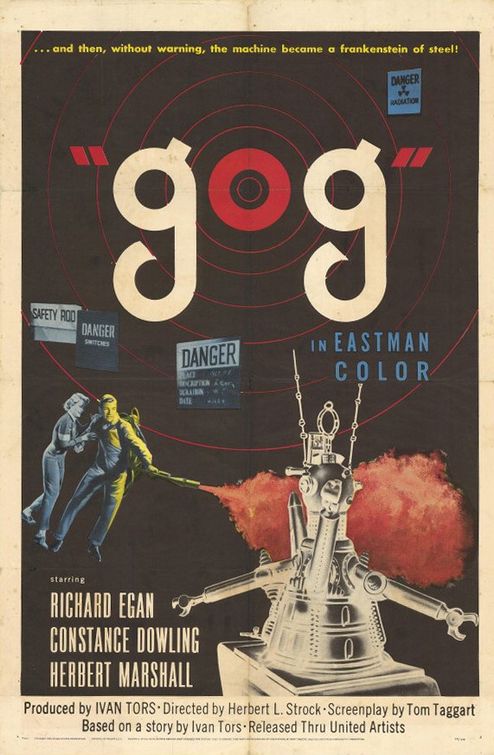
Scientists working on induced hibernation for space travel are killed, apparently by machines acting independently. Security agent Sheppard arrives at the secret underground space research base to investigate possible sabotage. He finds that the whole base is coordinated by supercomputer NOVAC and its robots Gog and Magog; and a strange aircraft is detected high overhead.
In an overpopulated futuristic Earth, a New York police detective finds himself marked for murder by government agents when he gets too close to a bizarre state secret involving the origins of a revolutionary and needed new foodstuff
"Cardinal Richelieu and his power-hungry entourage seek to take control of seventeenth-century France, but need to destroy Father Grandier - the priest who runs the fortified town that prevents them from exerting total control. So they seek to destroy him by setting him up as a warlock in control of a devil-possessed nunnery, the mother superior of which is sexually obsessed by him. A mad witch-hunter is brought in to gather evidence against the priest, ready for the big trial."
Easily the best version of Dracula filmed to date, this BBC television production was originally presented as a three-part miniseries. This version hews fairly close to the original novel, including a fairly extended version of Harker's adventures at Dracula's castle, Lucy's sleepwalking in the cliffside graveyard at Whitby (apparently shot on location, with the famous long stone staircase of Whitby memorably showcased), and a final chase across the "Transylvanian" countryside.
Louis Jordan (of "Gigi" fame) seems an odd choice to play the Count, but proves to be surprisingly effective. Beneath his courtly Continental manners, he manages to imply a will of steel and an otherworldly coldness. Frank Finlay is also memorable as the comically eccentric Professor Van Helsing, whose habitual lightness of manner makes his occasional serious moments more impressive by contrast. (The BBC lost a great opportunity by never casting Finlay as Dr. Who.) The comely Susan Penhaligon vamps her way outrageously through her role as the flirtatious Lucy, and her interludes with the Count are some of the more torridly suggestive that have been filmed in a serious movie. When her vampire tendencies start to surface, once can sense a current of barely concealed mirth in Penhaligon's performance. The other performers are more perfectly in character, with Mark Burns showing a tortured gravity as Lucy's hopeless admirer Doctor Seward; Richard Barnes as Quincy has the comical Wild West accent ascribed to the character in the novel. The improbably named Bosco Hogan makes Jonathan Harker's vulnerability and desperation very real. Jack Shepherd is a memorably intense Renfield, a grotesque but surrealistically poetic and finally tragic figure. Finally, Judy Bowker as Mina Westenra/Harker overshadows the male leads, as she must, with her nobility in the face of her own creeping transformation.
The special effects in general are primitive by today's standards, but always interesting and atmospheric. The storm scene with a model ship bobbing about on slowly undulating black sheets seems to show great inventiveness in the face of a limited budget. Other psychedelic visual elements enhance the otherworldly character of the story. The treatment of the story as a metaphor for Victorian sexual repression is typical of more recent productions and may have served to influence the campy Bram Stoker's Dracula and Dracula: Pages from a Virgin's Diary. However, the usual modern device of tying Dracula to his historical namesake, is only briefly hinted at here by woodcuts of the Impaler's work in the opening credits.
While the hot rodders and motorcyclists are having a rock-and-roll beach party, a barrel of radioactive material is unloaded from a passing ship, plunges to the bottom and splits against a jagged rock. A black liquid oozes out and covers a shapeless mass on the ocean floor, which suddenly moves and becomes an encrusted vicious monster. Soon there are several monsters and they must have human blood to survive. Tina is the first victim, and football hero Hank Green and airhead Elaine Gavin enlist the aid of her science-professor father, Dr. Gavin, to solve and capture the killer. Not working fast enough to prevent the attack on twenty teen-agers at a slumber party nor the killing of three girl motorists, Dr. Gavin finds an arm lost by one of the monsters and discovers that only sodium will destroy the monsters whose composition is mostly water. Can they gather enough salt in southern California to put an end to this horror?
The Creature from the Black Lagoon is back! This time he's captured by scientists and transported to an aquarium in south Florida. Naturally, he's attracted to the lovely female scientist and manages to escape and kidnap her, heading to Jacksonville, presumably to catch a Jaguars game.